As people look to more natural ways of growing food and habitat for wildlife, a slew of names and terms are being thrown at gardeners and farmers that overlap and all point to the same thing: ecological principles applied to productive gardens or farms. Some of these terms are faddy while others help explain certain processes. Personally I find most of these buzzwords unhelpful because they overcomplicate rather than simplify what is actually an easy to understand topic.
Agroecology: applying ecological principles to agriculture.
Agroforestry: growing agricultural crops alongside trees for forestry.
Ecology: the science of studying living organisms, how they interact with one another and their physical surroundings.
Ecological gardening: applying ecology principles to gardens.
Ecosystem: all living things in an area living and interacting with one another and their physical environment.
Edimental: edible + ornamental.
Food forest / forest gardening: growing productive food crops in a layered plant community.
Hügelkultur (Dutch: Hügelbeet): a raised planting area that places dead plant matter at the base in a layer for natural decomposition to occur. Typically with logs at the base, then twigs followed by grass, veg waste and other leafy or green matter at the top followed by soil or compost to plant into. Helps with water retention, slow release of nutrients and some warmth from microbial activity, like a compost heap.
Intercropping: growing two or more crops in the same piece of land to maximise yield.
Nature based gardening: working with natural systems rather than against them to help wildlife, improve soil health and create self-sustaining plant communities.
Natural ecosystems: ecosystems found naturally in the wild, not created by humans in gardens or on farms.
No-dig / no-till: growing crops with minimal soil disturbance to protect subterranean life and soil structure.
Organic gardening / agriculture: growing crops without the use of synthetic chemicals (though it’s worth noting that some organic farmers are allowed and do sometimes use minimal amounts of chemicals in emergencies – but this is significantly less than in non-organic farms and many organic farms use none at all).
Permaculture: permanent + agriculture, a planned area of crops mimicking the long-term sustainability and resilient of natural ecosystems.
Plant community: all of the plants growing in a particular area and how they live alongside and interact with one another over time; the plant part of an ecosystem. Self-sustaining, or at least, that’s the aim. (Read more about edible plant communities).
Polyculture: poly- means many and culture comes from agriculture or horticulture. Polyculture is also the opposite of monoculture where a single crop is grown in an area. It means to grow many different crops in the same area. Really it’s another term for plant community.
Regenerative gardening / agriculture: growing in a way that improves an area of land for wildlife and carbon capture. Essentially it’s a buzzterm for actively restoring and improving the ecological processes in a garden or on a farm. In relation to food, regenerative growing or farming means to produce usable crops while also improving the land for wildlife and carbon capture. (See also sustainable gardening / agriculture below).
Silvopasture: trees grown on pasture land with livestock grazing around them, the trees are crop plants such as fruit or nuts to increase the yield of food from the same land (see also wood pasture below).
Sustainable gardening / agriculture: growing in a way that doesn’t impact the planet of wildlife negatively. Maintains the levels of wildlife in a plot and doesn’t contribute to atmospheric carbon release negatively. (See also regenerative gardening / agriculture above).
Syntropic gardening / farming: buzzterm for plant communities and ecological practices applied to food growing.
Wood pasture: ecological term for pasture grasslands with trees and shrubs growing in them. More about wildlife habitats than for food growing (see silvopasture above).
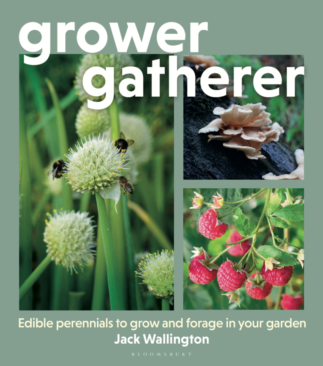
Explore edible perennials and forage gardens in Grower Gatherer
Discover a curated selection of delicious, easy to grow perennial vegetables, fruit, herbs, nuts, fungi and edible flowers – and how to combine them into beautiful, productive plant communities.